
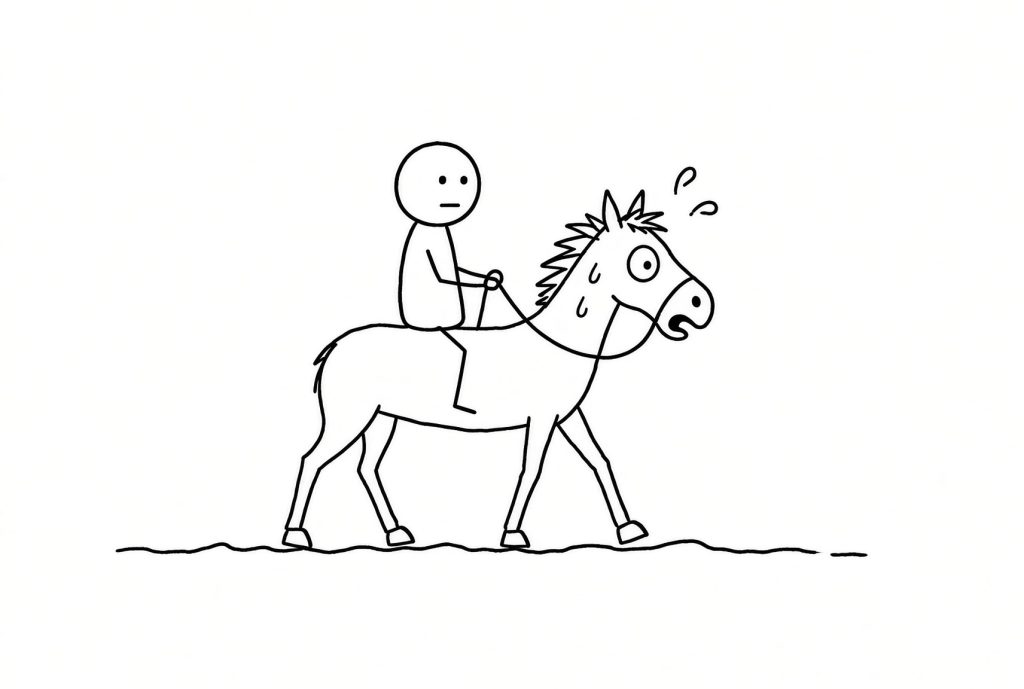
You are not your anxious body or your looping thoughts. The feeling of I is the rider. The body is the horse. The rider can stay calm even when the horse is anxious or panicking!
Video 13 from my course, in plain language.
Who (or what) is the feeling of I?
I want to start with a sentence I have heard thousands of times, and I used to say it myself.
I don’t know what’s wrong with me. My mind won’t shut up and it’s making me feel anxious.
Have a look at that.
I. Me. My.
That is three different positions in one moan. And we treat it as if it is one person with one problem that needs one answer. It isn’t. That is why people stay stuck. They keep asking the horse to explain the rider, or the rider to become as frightened as the horse.
If you have anxiety, OCD, Pure OCD, bipolar depression or that ADHD racing mind, you already know what the noisy bit feels like. Tight chest. What if. Can’t sleep. Look silly. Not safe. The whole circus.
The useful question is not “what’s wrong with me?”
The useful question is: who, or what, is the feeling of I?
Because there is a part of you that has the OCD story, and there is a part of you that bought into this work because it has had enough. Those are not the same part. If you keep aligning with the old story, you get the old life. If you align with the part that wants change, you have a chance.
You are not doing half of what you take credit for
Wiggle your fingers.
You did not sit there issuing commands to every tendon. The body did it. You swerve a car, you catch a cup, and then this sensation of I turns up late and says, “wow, I’m a really good driver.”
The body does not need your running commentary. This feeling of I needs the body. That is an important split.
So I use a simple picture.
The body is the horse.
The feeling of I, the observer, is the rider.
No rider fully controls a horse. A young rider gets dragged about. A calm rider can feel the animal lurch and still keep a quiet hand. A horse whisperer can be alright even when the horse is not.
Can you see where I am going with this?
You are not the horse.
At best you are the rider.
The horse does not even need you.
You need the horse, because it is the vehicle that carries this feeling of I through a life.
If your OCD happens to be about horses, pick another picture. A dog. A car. It does not matter. OCD will try to sabotage the metaphor anyway. That is what it does. Don’t argue with it. Change the picture and get on with it.
What I actually is
I am going to say this in ordinary words, because I am not trying to start a religion.
The feeling of I is the bit that can watch.
It can notice a thought without having to become the thought.
It can feel the body take off and still know: that is the horse.
It does not shout. The horse shouts. Volume is not the same as truth.
People look for I in the next thought. They won’t find it there. Thoughts are objects. I is that which can see an object.
They look for I in the tight chest. That is weather in the animal.
They look for I in a label. “I am an anxious person.” That is last year’s story wearing a name badge.
If Soul is a word that still works for you once you take the church off it, that is fine. I often call it the rider of the horse. Same job. The bit that can stay. The bit that does not have to join the panic for the panic to be happening.
This is the point I want you to test, not believe.
The horse can be in a state.
The rider does not have to be.
You do not need the body to go quiet first before you are allowed to be the rider. That is the trap. People wait for the feeling to agree, then they will take action. The feeling is an eight-year-old protection system. It wants certainty, no embarrassment, no contamination, no looking silly. If you wait for that child to give you permission, you will wait a long time.
The rider can hear every what-if and still walk the horse into the box.
The theatre inside the horse
The horse’s mind is not one voice. It is a cheap soap opera.
The narrator describing everything.
The judge ranking you against everybody else.
The victim taking the beating when the judge loses.
The pleaser saying yes while the others complain.
You can only beat yourself up if one part is doing the beating and another part is taking it. That is not proof you are broken. That is proof you have more than one character, and they were trained when you were small.
As the rider you can watch that play without auditioning.
The foot hurts. Fine.
I am ruined. That is a promotion. You just made a sensation into an identity.
The horse’s mind is proposing that I am an idiot. Fine.
I am an idiot. That is a merger. You just sat in the wrong chair.
Calm does not mean the horse has shut up. Calm means you stopped treating the horse’s mood as the meaning of I.
What to do with this
You cannot sack the horse. You live in it.
You can calm it, trick it, placebo it and retrain it. It was trained once. It can be trained again. That is what exposure is. You point the animal at the life you actually want and at the person you want to become, and you stop feeding the old response.
Courage is not the horse going quiet first.
Courage is you feeling the fear in the saddle and still acting toward what you intend and desire.
Knowing this in a chair is knowledge.
Walking it when the chest is tight is wisdom.
The people who act, adjust and act again will always get further than the people who sit there thinking about the horse.
A small piece of homework
Sit somewhere ordinary. Don’t improve the moment. Just watch what is happening.
The little horse will turn up with judgements, old films, future disasters and a request that you take it personally.
Notice there is a seeing of all that.
That seeing is not shaking even if the body is.
That seeing does not need the next thought in order to exist.
That is closer to the feeling of I than any diagnosis you have been carrying.
If you put your awareness on the ache, the horse gets bigger.
If you put it on a cloud, the same afternoon changes.
Same outer world. Different inner one.
Learning where to put your attention is a skill. Skills get better with practice.
This is Video 13 in The Calmness in Mind Process, where I discuss how iStory ERP is the walking version of the same idea. You don’t expose a label. You expose the life you mean to live, while the horse complains and you keep the line.
Access this video and over 60 others for $15 a month, along with guided meditations and practical workbooks. These are The Chronicles of Common Sense, forged from facing life directly and learning through real-world experience. They guided me out of anxiety, OCD, bipolar depression and crippling self-consciousness, and helped me become more trusting, energetic, optimistic, self-loving and courageous.
This work reaches the mind, body and soul. The next action is yours. Take it.