
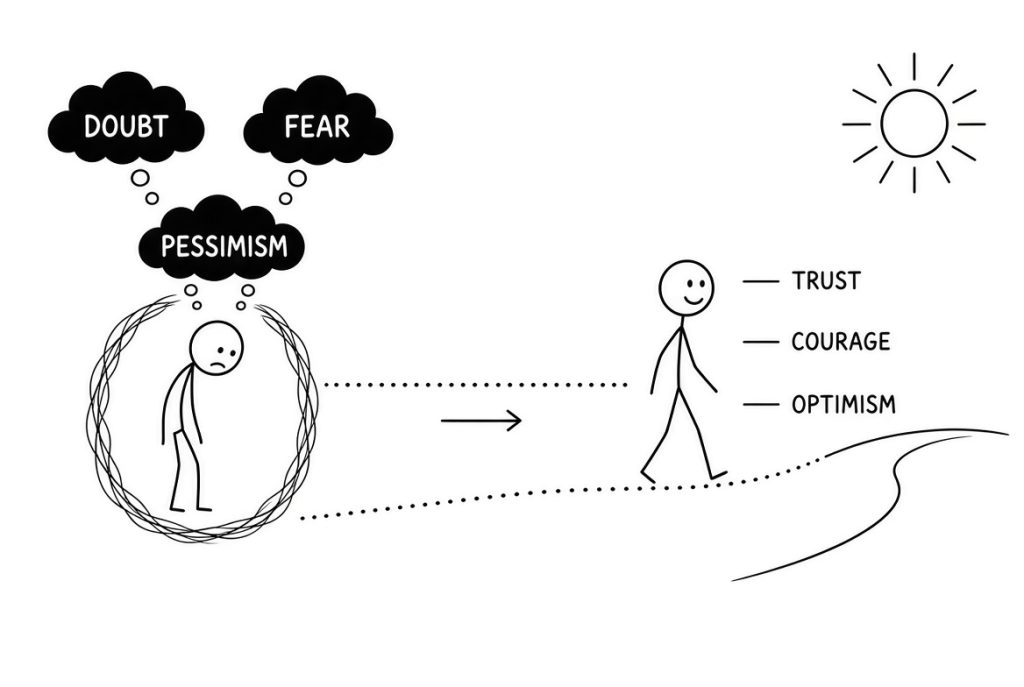
OCD runs on doubt, fear and pessimism. Lasting change comes from becoming someone who practises trust, courage, and optimism—and uses iStory ERP on the life they actually want, not just the latest feared thoughts or uncomfortable emotions.
To Overcome OCD, Move from Doubt, Fear and Pessimism to Trust, Courage and Optimism
OCD is often described as thoughts. That is only the surface. Underneath, it runs on three fuels: doubt, fear and pessimism.
Doubt says you cannot move until you are sure.
Fear says the feeling in the body is a warning you must obey.
Pessimism says the future is dangerous unless you manage it in advance.
If those are the fuels, more analysis will not save you. The mind that created the loop is very good at producing better questions. The way through is a change of stance: trust, courage and optimism — practised until they become the new default.
Trust is not certainty. It is going forward without the guarantee.
Courage is not the absence of fear. It is feeling exposed and taking the next action anyway.
Optimism is not pretending the world is safe. It is briefing the brain toward the life you want instead of toward the disaster it is so skilled at inventing.
That shift is what I mean by becoming a new person. Not a stranger. The same human, running a different operating system.
A lot of people want the OCD to leave so they can remain who they already are. That keeps the system employed. The themes can change — harm, contamination, relationships, religion, the body, existence — and the job stays the same: hunt for certainty, treat thoughts as verdicts, put life on hold.
I keep seeing two broad types.
Some people with OCD are short of ordinary life skills. They were never really taught how to decide, say no, recover from a mistake, start something imperfect, or be with people without a script. Anxiety then covers for the missing skill. For them, becoming someone new includes learning the basics the nervous system has been doing by fear.
Others are almost the opposite. They are so quick that the ordinary world looks clumsy. Advice sounds beneath them. What they often miss is that the same intelligence is being used as a defence. A mind that can out-argue every method can also out-argue recovery. They are not average. The gift is real. So is the trap.
If that is you, the move is not to become less clever. It is to stop spending the cleverness on doubt. Do the ordinary thing while the mind explains why this cannot apply to you.
What the old stance does
The old person needs to understand the thought before they act.
The new person acts toward what they desire and lets understanding catch up.
The old person uses reassurance to get through the next ten minutes.
The new person sits with the discomfort and updates the inner story.
The old person waits to feel ready.
The new person does the next useful thing while not ready.
The old person is loyal to “I am an OCD sufferer,” or “I am too complex for simple tools.”
The new person may still have a noisy mind. They do not build a life around the noise.
This is why I keep asking: who do you wish to become, and what do you desire to do with your life? Those questions are the brief for ERP. You expose yourself to the life that would exist if fear were not in charge. You prevent the old responses — checking, avoiding, reviewing, confessing, googling — from vetoing it.
You cannot stay the same and expect a different nervous system. Repeat trust, courage and optimism in small, real actions and the brain updates. That is training, not a slogan.
Family and the old identity may push back. Doubt dressed as caution. Fear dressed as love. Pessimism dressed as being realistic. Be sceptical of those voices, and listen long enough to test a better one.
If you have Pure OCD, do not chase the latest theme. The theme is bait. Change the relationship to uncertainty and the bait works less well.
You will not wake up as someone else. You will notice that you did the thing anyway. You left the thought unchecked. You went to the place. You asked. You did not wait for the feeling of done. That is the new person arriving in pieces.
OCD wants you to wait until you are sure. Trust, courage and optimism are how you stop waiting.
The course exists to make that shift practical.
It does not ask you to wait until you feel like a new person. It teaches the skills that build one: how the system works, how to stop feeding it, how to sit with discomfort, how to change the inner story, and how to point ERP at the life you actually want.
You learn more self-awareness — not as endless self-examination, but as the ability to notice the old stance of doubt, fear and pessimism and choose another. You practise talking to yourself differently. You practise acting before the mind has finished arguing. You retrain attention, memory and habit in the direction of trust, courage and optimism.
That is the work. Information helps. Repetition in real life is what installs the new direction. The videos, meditations and workbooks are there so you have a process to follow while you become someone who can use it.
Access this teaching and over 60 other videos for $15 a month, along with guided meditations and practical workbooks. These are The Chronicles of Common Sense, forged from facing life directly and learning through real-world experience. They guided me out of anxiety, OCD, bipolar depression and crippling self-consciousness — and helped me become more trusting, energetic, optimistic, self-loving and courageous.
This work reaches mind, body and soul. It gives you the tools to step courageously into the unknown. Knowledge only becomes wisdom when we test it through action. Those who act, adjust, and act again (ERP) will always move further than those who stay in thinking and worrying.
What do you desire?
The next action is yours. Take it.