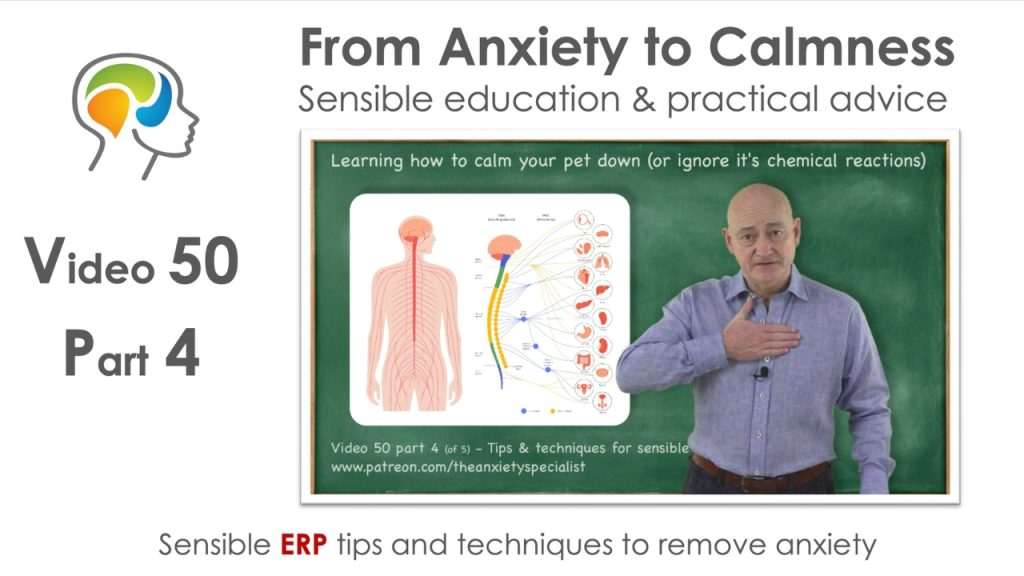
Effective ERP means acting toward the life you want while anxiety is still present. Learn how to reverse negative patterns, treat processes as processes, and stop letting sensations dictate the next move.
How to Stop Responding to Anxiety while using ERP to build the life you want.
This is an excerpt from lecture 50, part 4 of The Calmness in Mind Process.
Exposure and Response Prevention works best when you stop treating every anxious thought or bodily sensation as an instruction. The practical version is straightforward: expose yourself to the behaviours and attitudes that move you toward who you want to become, and consciously prevent the old brain and body from dictating the next move.
Most anxious people are already doing a form of negative ERP without noticing. They repeatedly think about what scares them, avoid what feels uncomfortable, and reinforce the very patterns that keep them stuck. The corrective is to reverse the direction. Decide who you want to be—more social, more decisive, less perfectionist—and begin acting that way now, even while the old sensations are still present. Courage is simply feeling vulnerable and acting anyway.
Almost everything is a process. Showering, locking a door, asking someone for coffee, saying no, applying for a job—these are sequences of steps, not emotional crises. When the brain or body demands five showers a day or endless checking until a “completion feeling” arrives, the useful response is not to argue with the feeling. It is to adopt the process used by people who do not have the problem: one short shower, one check of the door, then move on. Sit with whatever discomfort remains and run a deliberate new internal story: “This is the process. My old rules were wrong. I am choosing the life I want.”
The same principle applies to intrusive thoughts. The brain of an exhausted or unbalanced person often generates the opposite of who that person actually is—harm thoughts for someone who would never harm, contamination fears for someone who values cleanliness but not obsession, relationship sabotage for someone who wants connection. These thoughts are attention-seeking signals, not prophecies. Treat them as noise, re-engage with the situations the anxiety originally pulled you away from, and install clearer, kinder internal dialogue.
When the body is already activated, several practical interruptions can reduce the intensity without requiring you to “feel better” first. Tapping sequences, learning to juggle (which occupies both brain hemispheres and eye-tracking), double sharp nasal in-breaths followed by a long out-breath, holding the thumb while focusing on the pulse, or firm taps over the vagus nerve points while breathing slowly all give the nervous system something else to do. The “bring it on” approach is also effective: instead of resisting the sensation, gently invite it to increase. The rider does not have to share the horse’s panic.
Desensitisation of the senses themselves helps. Walking in public with noise-cancelling headphones on silence, or standing with eyes closed in a busy place, trains the system that constant hyper-vigilance is not required. Over time the body learns it can function without continuous scanning.
Language matters. Replace “I hate conflict” with the more accurate description: honest communication that places your own well-being first. Talk to yourself the way you would talk to a nervous child you care about—“You can do this,” “This is not my problem,” “I choose to let that go.” Drop the identity of “empath” if it keeps you absorbing other people’s pain; awareness does not require joining the feeling. Use any vices as rewards after action rather than as numbing agents for avoidance. And reframe risk: the greater risk is usually remaining stuck in a life that drains you.
None of this requires the sensations to disappear first. The goal is to accept that the body can feel nervous while you continue acting in line with your intentions. Anxiety symptoms are secondary; the primary problem is exhaustion and a life that does not match what you actually want. Change the process, install new stories, keep moving toward the desired direction, and the old responses gradually lose their grip.
Begin The Calmness in Mind Process
Access this video and over 60 others for $15 a month, along with guided meditations and practical workbooks. These are The Chronicles of Common Sense, forged from facing life directly and learning through real-world experience. They guided me out of anxiety, OCD, bipolar depression and crippling self-consciousness — and helped me become more trusting, energetic, optimistic, self-loving and courageous.
This work reaches mind, body and Soul. It gives you the tools to step courageously into the unknown. Knowledge only becomes wisdom when we test it through action. Nature just knows that those who act, adjust, and act again (ERP) will always move further than those who remain stuck in overthinking and worrying.
Thinking is an Inner Reality Imagination. Action is an Outer Reality Event — and once you act, something will happen. The outcome is never fully in your control, but if the action is aimed at what you truly desire, it is always worthwhile.
What is it you desire?
The next action is yours. Take it.
Much love, John
www.calmnessinmind.com
You can gift this course to others at checkout if you have their email address.